
Fireworks can transform any event into a magical display, regardless if it’s the Fourth of July, New Year’s Eve, or your wedding night. But if you enjoy fireworks, you’ve probably asked yourself at least once how fireworks are made.
Here’s one thing we can say for sure: it’s more than just a simple process. The word “pyrotechnic” comes from the Latin words for “fire” and “skill,” and similarly, its creation is also a blend of art and precise science.
Important Parts of a Firework

Before we get into the fireworks manufacturing process, let’s talk about what makes up a firework in the first place.
Shell
The shell refers to the part of the firework that keeps everything tucked neatly inside until it’s ignited. This is a sturdy outer casing made of different materials, depending on the type of firework and the manufacturer.
Common materials used for fireworks shells include plastic, heavy-duty paper, and even papier-mâché. While all of them are good for protecting the inner parts of a firework, they do come with their own pros and cons as well.
Propellant
Propellants are what give the firework the energy to actually ignite. It’s typically found at the shell’s base, where it can provide the most power.
The term “propellant” can refer to both the compartment that contains the explosive material, as well as the material itself.
Usually, the compartment is made of iron or aluminum. It can also be made of plastic or heavy cardboard.
Inside, it contains a powder that allows the firework to ignite. The most common powder used is black powder, also known as gunpowder. It’s made of saltpeter (potassium nitrate), sulfur, and charcoal, giving it its characteristic black smoke.
Flash powder is another option. It’s a compound made with potassium chlorate or potassium perchlorate mixed with aluminum and sulfur.
Flash powder produces a louder sound than black powder, but it’s not as stable. More importantly, it’s also more powerful. This is why commercial fireworks that use flash powder rarely contain a large amount of it. It’s mostly military-grade explosives that contain plenty.
Stars
Stars, also known as pyrotechnic stars, contain the rest of the substances that are needed to keep the firework burning.
Oxidizer
True to their name, oxidizers contain chemicals like potassium perchlorate or ammonium perchlorate that carry oxygen needed for the firework to burn.
But oxidizers don’t just help with the combustion – they also make sure that the colors are as vibrant and as long-lasting as possible.
They do this by reacting to the chemicals in the fireworks that produce color. More on this below.
Fuel
Firework fuel does more than just keep the firework going. It also controls how the firework burns – whether you want it fast or slow, hard or soft.
For instance, manufacturers can add slow-burning fuel that contains charcoal or dextrin to create a soft, lingering glow. Meanwhile, fast-burning fuel with aluminum or magnesium can be used to create dramatic, fleeting bursts in the sky.
By the way, did you know that sugar is also sometimes added to firework fuel to create a white smoke effect? Sugar–as well as starch–is rich in carbon, which blocks the oxygen that normally inhibits the smoke.
Colorant
The magic behind a firework display’s mesmerizing colors lies in various metal salts and chemicals that burn at different temperatures.
For instance, aluminum, magnesium, or titanium can create pure whites, while compounds of sodium bring out vivid yellows.
Strontium carbonate produces rich reds, and barium compounds give off vibrant greens. Copper compounds, on the other hand, provide brilliant blues.
How Fireworks are Made: Step-by-Step
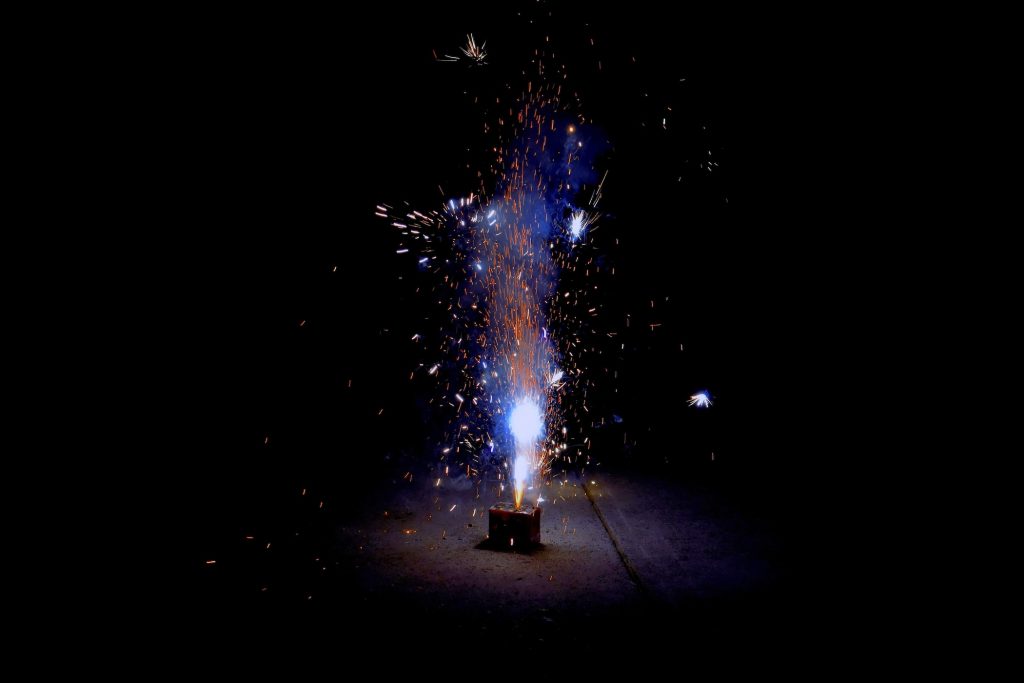
Now that you know all the main parts of a firework, let’s talk about how fireworks are made step by step.
Disclaimer: The fireworks manufacturing process can be extremely dangerous. This guide is only meant as a reference, not an actual guide to help you create your own fireworks.
- Designing the fireworks. The first step involves coming up with a design for the fireworks. This includes the color, size, and effects once ignited, which, as mentioned above, can affect what chemicals and materials will go into the final product.
- Preparing the shell. Next comes the shell. As mentioned above, it can be made from various materials, depending on the manufacturer and type of firework that will
- Mixing the chemicals. Once the shell is ready, the chemicals can be mixed. Traditionally, they’re sifted in wooden barrels using brass tools to avoid accidentally setting off sparks.
- Creating the stars. The dough is molded to form the stars. These pellets will be holding important and dangerous compounds, so they needy to be made with precision.
- Filling the shell. With the stars complete, the shell can be filled. Depending on the type of firework, the insides of a shell can have different arrangements. A burst charge is usually put at the center of the shell though to make sure it explodes at the correct altitude.
- Closing the break. The shell, known as the break, can now be capped off with paper. Any remaining space may also be filled with more powder so that the stars could disperse properly.
- Adding other components. Now it’s time to add the other components, if any. Some fireworks have a mortar, which contains the shell until it’s time to ignite. There’s also a fuse that matches the expected timing for ignition.
- Final assembly. After that’s done, all the parts will be connected securely. Everything should be well-sealed to prevent accidental ignitions.
- Safety checks. Finally, a sample firework will be tested in a controlled environment. This is to make sure that it functions the way it’s supposed to be. It will then be packed with protective material and labeled with clear safety instructions, ready to find its way to the store and picked up for a dazzling display.
Final Thoughts
And that’s it for the process of how fireworks are made. It’s pretty clear now that behind every burst of color lies a blend of artistry and technical expertise.
For those who want something more, you’ve come to the right place. Here at Missile Fireworks, we provide top-tier products and customized display services that can instantly elevate any celebration.
Check out our offerings today and light up your next event with a fireworks display that can leave everyone spellbound!
Come See the Full Selection
Browse our fireworks online and send an order request, then pay and pick up at any of our 3 Oklahoma stores.
🎇 Shop Now 💬 Ask Us a Question